
Agents in Construction (AiC) Ontology
Release: 20.06.2026
- This version:
- https://w3id.org/aic/1.1.0
- Latest version:
- https://w3id.org/aic#
- Previous version:
- https://w3id.org/aic/1.0.0
- Revision:
- 1.1.0
- Issued on:
- 20.06.2026
- Authors:
- Irfan Čustović, TU Delft
- Jianpeng Cao, HKU
- Ranjith Soman, TU Delft
- Contributors:
- Pieter Pauwels, TU Eindhoven
- Daniel Hall, TU Delft
- Hans Wamelink, TU Delft
- Download serialization:


- License:


- Visualization:

- Evaluation:
-blue.svg)
- Cite as:
- Čustović, I., Cao, J., Soman, R. (2026). Agents in Construction (AiC) Ontology - Version 1.1.0
Abstract
The Agents in Construction (AiC) ontology is a lightweight semantic model for coordinating on-site production in construction. It represents construction agents (human workers, robots, and other autonomous hardware) and their state as they operate on a site: the processes they carry out, the elements they modify, the resources they handle, and the operational modes and metrics used to assess their performance and impact. To express how agents' operations evolve over time, AiC introduces meta-properties that specify when a statement holds (at an instant or over an interval), what dimension of information it represents (planned, simulated, or performed), and who generated it. The ontology emphasizes generic, trade-agnostic concepts to ensure broad applicability across project types and delivery methods.
The namespace for AiC terms is https://w3id.org/aic#
The suggested prefix for the AiC namespace is aic
The AiC ontology is a deliverable of the research project  Smart Mobile Factory for Infrastructure Projects (SMF4INFRA).
Introduction back to ToC
The AiC is designed to formalize and describe how various agents execute work during construction. Its primary objective is to enable a consistent digital representation of agents on the site (human workers, robots and other autonomous machines), their states and their interactions with other entities. These interactions may be physical, such as handling materials or equipment and occupying work zones, or non-physical, such as requesting materials or directing attention toward a specific element, material, or task.
Scope
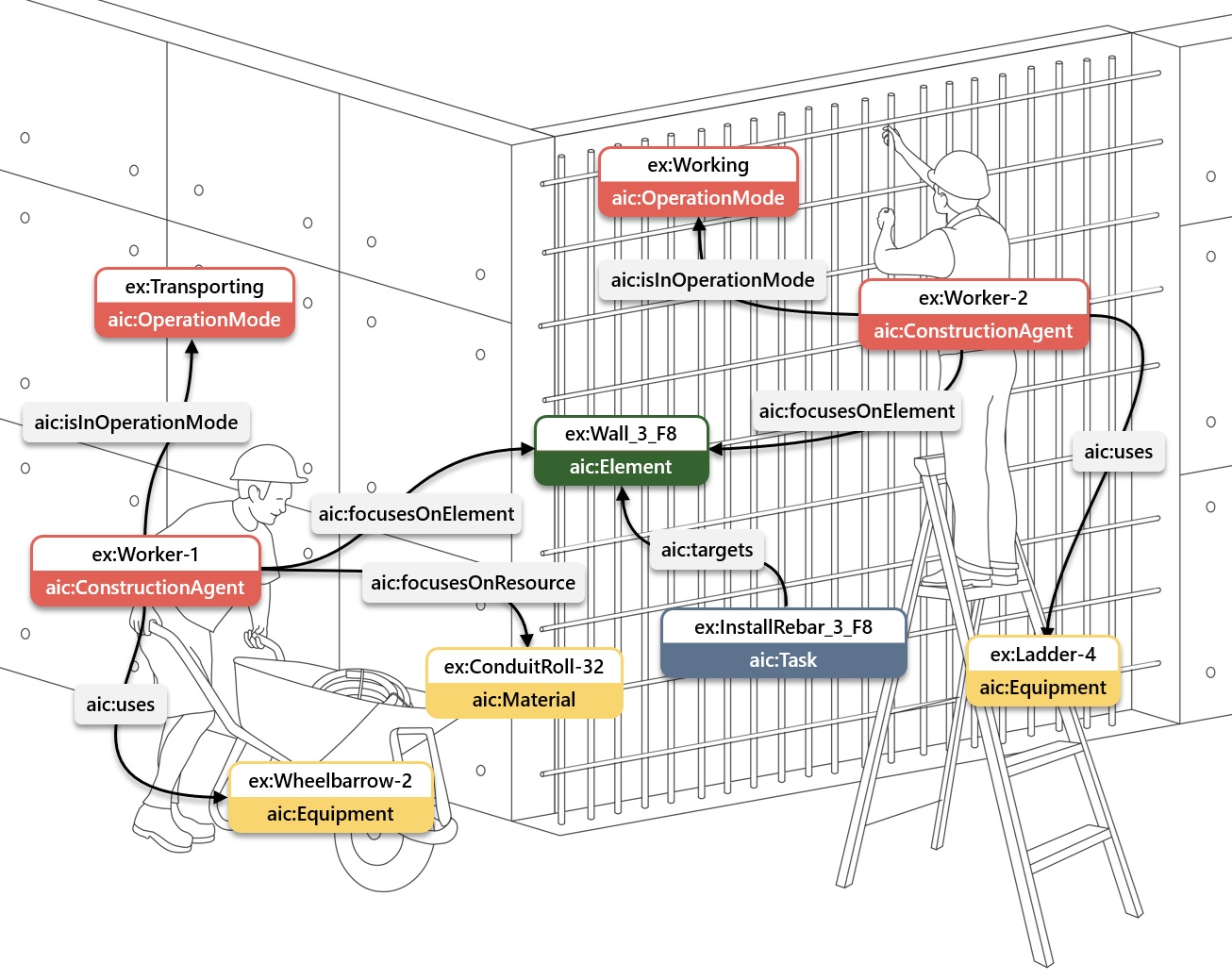
Figure 1 illustrates a typical construction-site situation and exemplifies the type of information that the AiC ontology is intended to capture. In this example, two workers are preparing rebar and mounting components for a concrete wall. Their internal state can be represented as follows: Worker 1, shown on the left, is in a “transporting” mode, while Worker 2, shown on the right, is in a “working” mode. Their interactions with other entities are also represented. Worker 1 is using a wheelbarrow, with its operational focus on the material instance “ConduitRoll-32” and the element “Wall_3_F8”. Worker 2 is using a ladder to position rebar beams, with its operational focus directed toward the same element, “Wall_3_F8”.
Namespace declarations
| aic | <https://w3id.org/aic#> |
| owl | <http://www.w3.org/2002/07/owl#> |
| rdf | <http://www.w3.org/1999/02/22-rdf-syntax-ns#> |
| rdfs | <http://www.w3.org/2000/01/rdf-schema#> |
| terms | <http://purl.org/dc/terms/> |
| vann | <http://purl.org/vocab/vann/> |
| xml | <http://www.w3.org/XML/1998/namespace> |
| xsd | <http://www.w3.org/2001/XMLSchema#> |
AiC Ontology: Overview back to ToC
Classes
- Activity
- Agent Capability
- Construction Agent
- Consumable Material
- Creator
- Element
- Equipment
- Indicator
- Information Dimension
- Information ID
- Material
- Mode Metric
- Mode Set
- Operation Mode
- Process
- Process Metric
- Process State
- Reified RDF 1.1 statement
- Resource
- Resource Quantity
- Resource Type
- Reusable Material
- Task
- Work Package
- Zone
Object Properties
- belongs to
- consumes
- contains activity
- contains task
- corresponds to
- focuses on element
- focuses on process
- focuses on resource
- generated by
- has capability
- has element
- has information dimension
- has mode metric
- has predecessor
- has process metric
- has quantity
- has resource type
- has successor
- is assigned to
- is described by
- is in operation mode
- is in process state
- is located in
- is operating in
- object of a reified statement
- predicate of a reified statement
- reifies statement
- releases reusable material
- requests resource
- requests zone
- requires capability
- requires resource
- subject of a reified statement
- supplies
- targets
- uses
Data Properties
Named Individuals
AiC Ontology: Description back to ToC
Competency questions
| No. | Competency question | Reason for posing this question |
| Questions about statements valid irrelevant of time | ||
| 1.1 | What are the mode sets used to describe agent ABC? How do the modes from different mode sets correspond to each other? | Understand different ways to formally express the operation of an agent. |
| 1.2 | Which metric measures the performance of agent ABC when in operation mode XYZ? | Understand how the performance of an agent operating in a particular mode can be expressed. |
| 1.3 | Which metric is describing the performance of process 456? | Understand how the performance of a process can be expressed. |
| Questions about statements at a point in time | ||
| At time T1, ... | ||
| 2.1 | … what is the mode of agent ABC and since when has it been operating in that mode? | Find out the operation mode of the agent at any given point in time. |
| 2.2 | ... what element is agent ABC focusing on and since when has it been focusing on that? | Find out the physical elements that an agent is focusing on at any given point in time. |
| 2.3 | ... what process is agent ABC focusing on and what is the state of the process? | Find out the process and its process state that an agent is focusing on at any given point in time. |
| 2.4 | ... where is agent ABC operating, and since when has it been operating there? | Find out the location of the agent at any given point in time. |
| 2.5 | ... which process is assigned to agent ABC? | Find out what an agent has to work on at any given point in time. |
| 2.6 | ... what resources / zone is agent ABC requesting, and since when has it been requesting them? | Find out what an agent needs to execute its work at any given point in time. |
| 2.7 | ... what equipment is agent ABC working with and since when has it been working with it? | Find out the equipment usage of the agent at any given point in time. |
| 2.8 | … what is the value of the process metric of process 456? | Find out the dynamic performance of a process at any given point in time. |
| Questions about statements spanning periods of time | ||
| In the period up until time T2, ... | ||
| 3.1 | ... what material and in what quantity has agent ABC consumed already and when has agent ABC consumed it? | Find out how much material an agent has consumed that is not available anymore up until a given point in time. |
| 3.2 | ... what reusable material and in what quantity has agent ABC already provided, and when? | Find out how much material an agent has provided, which is available once again up until a given point in time. |
| In the period between time T3 and time T4, … | ||
| 3.3 | … in which modes was agent ABC operating, and for which time periods? | Find out the operation mode history of an agent in a specific period. |
| 3.4 | … what is the total time that agent ABC was operating in mode XYZ? | Quantify the agent's operating time in a specific mode. |
| 3.5 | … how often and how long was agent ABC requesting resource 123? | Quantify the frequency and duration of an agent's resource requests within a specific period. |
| 3.6 | … what is the total time that agent ABC was working with equipment 789 and focusing on process 456? | Find out the equipment usage of an agent dedicated to a particular process. |
Structure and Concepts
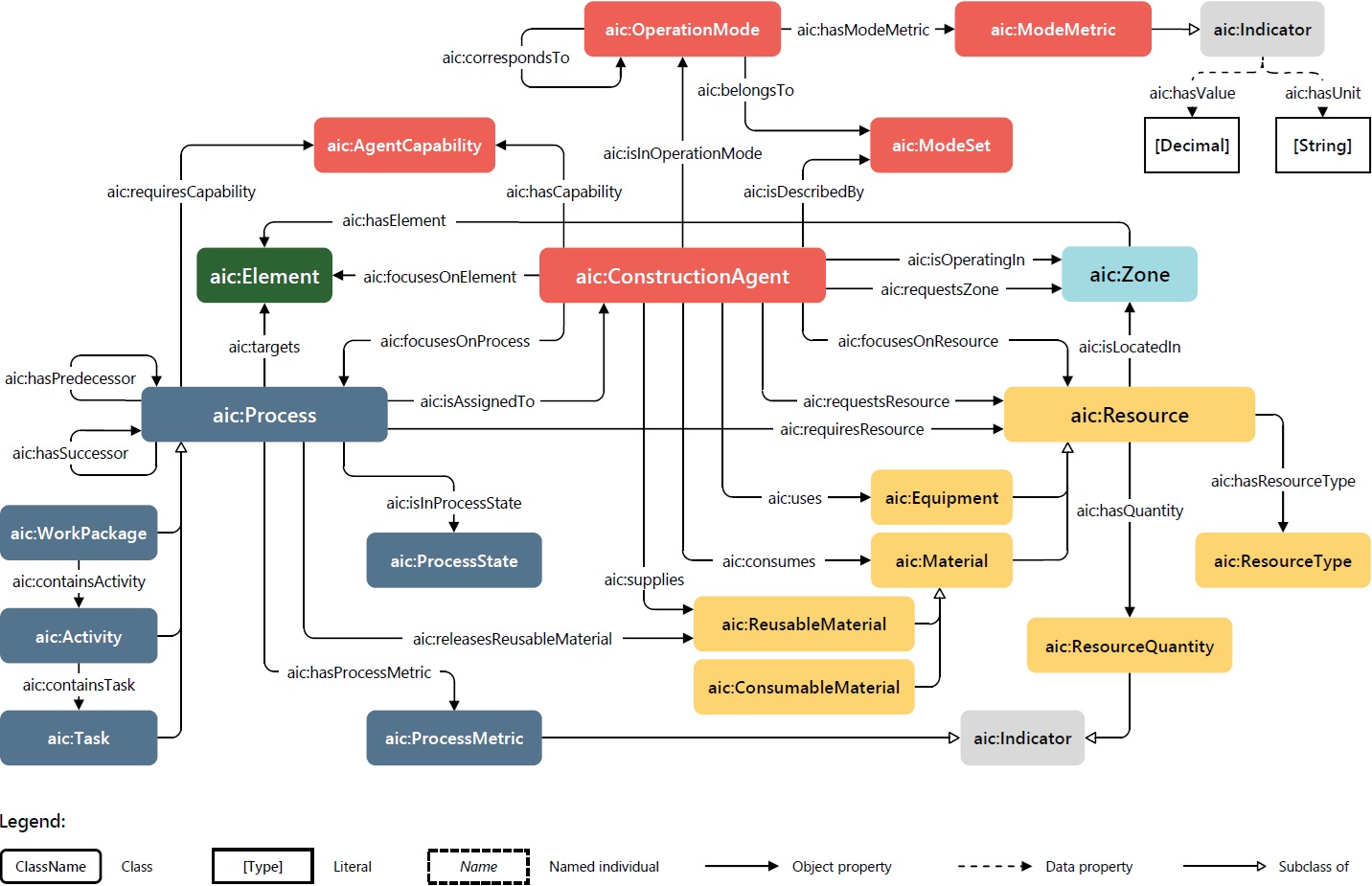
Figure 2 provides an overview of the classes and properties of the AiC ontology. They are organized into three groups that describe how agents operate on the site, execute processes and handle resources. An additional set of classes and properties is included to capture meta-information essential for representing the dynamic aspects of construction information.
Including metadata about AiC statements (temporal validity, planned vs. performed, creators, ...)
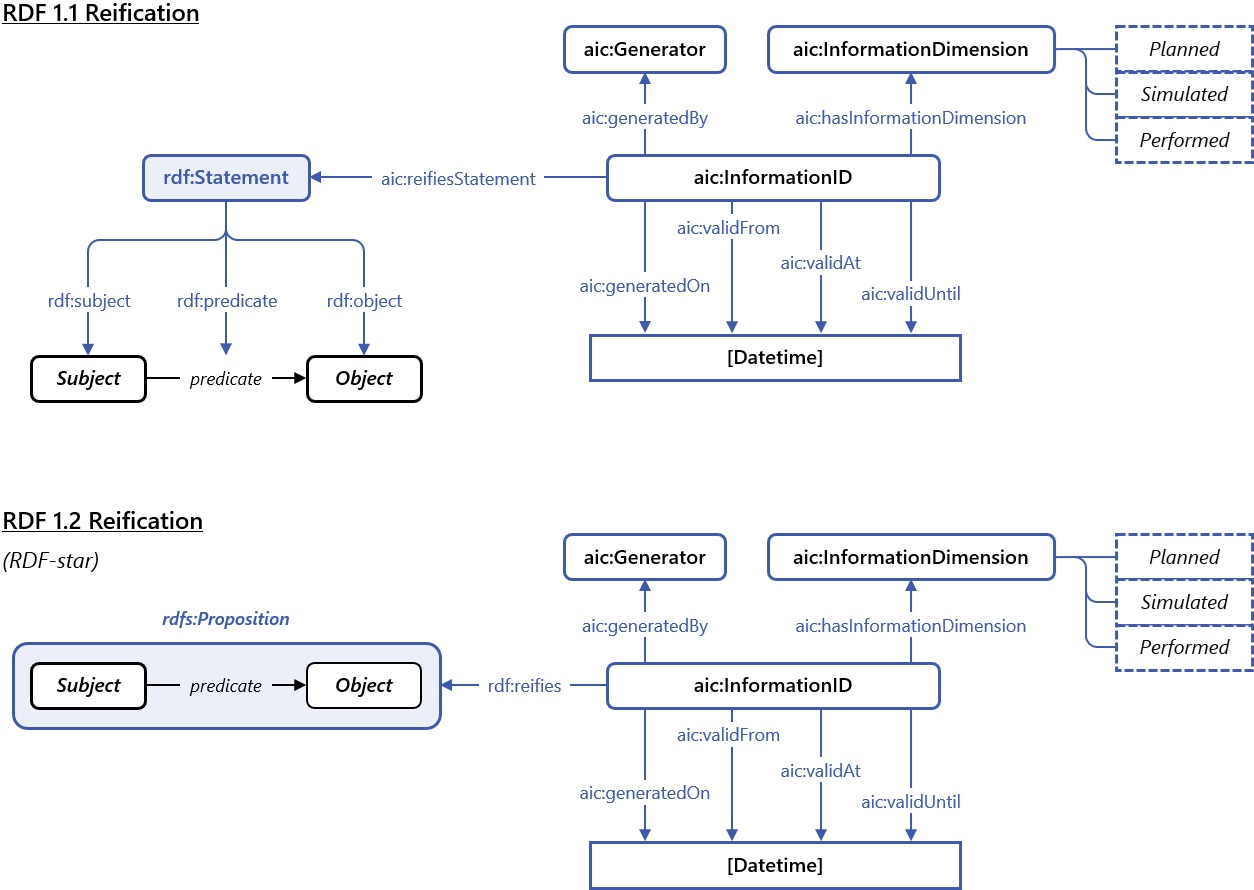
The AiC ontology formalizes statement-level metadata management through the class aic:InformationID, which acts as a reification construct linking factual assertions to contextual and provenance information. Each aic:InformationID instance links to a reified RDF statement via aic:reifiesStatement, where the statement itself follows standard RDF 1.1 reification using rdf:Statement with its rdf:subject, rdf:predicate, and rdf:object properties (see Figure 3, top). The AiC ontology supports statement-level metadata in a way that remains compatible with both RDF 1.1 toolchains and emerging RDF 1.2 features. RDF 1.2 introduces triple terms (quoted triples, previously known as ‘RDF-star’), which allow a triple to be referenced directly as the object of another triple. At the time when this version of the AiC ontology was released, RDF 1.2 had reached ‘Candidate Recommendation Snapshot’ status, but had not yet become an official W3C standard [RDF12-CONCEPTS]. While preserving a systematic mapping to RDF 1.2 quoted triples using rdf:reifies where supported (see Figure 3, bottom), the AiC ontology also allows aic:reifiesStatement to serve as a stable attachment point for statement-scoped metadata in RDF 1.1.
aic:InformationID class
Expressing temporal validity is central to the AiC ontology. The object properties aic:validAt, aic:validFrom and aic:validUntil allow each assertion to be qualified by an instant or interval during which it holds.
aic:validAt- an instant at which the statement is valid.aic:validFrom- the start of an interval during which the statement is valid.aic:validUntil- the end of that interval.
For instance, a statement that a construction agent aic:operatatesIn a particular aic:Zone might be valid only for a certain period. Several construction agents can focus on the same process at different times and in different ways. Because these temporal constraints attach to aic:InformationID rather than to aic:ConstructionAgent or aic:Process, AiC supports multiple concurrent temporal perspectives on the same underlying entities (e.g., overlapping assignments, interruptions, or revisions) without duplicating domain-level structures.
Another important design feature of the AiC ontology is its explicit separation of domain semantics from epistemic and lifecycle context. Rather than introducing dimension-specific predicates for planned or performed data, AiC annotates reified assertions using aic:hasInformationDimension, classifying the underlying statement as aic:Planned, aic:Simulated, or aic:Performed. This preserves semantic continuity across viewpoints: identical classes and properties capture intent, prediction, and observation, while the dimension annotation makes each assertion’s contextual status explicit. By externalizing perspective as metadata, the approach supports reusable query patterns, simplifies mappings, and reduces schema drift across lifecycle stages. Provenance is captured through aic:generatedBy (to an aic:Creator) and aic:generatedOn, enabling the graph to retain traceable origins for statement-level claims.
For example, this metadata can be used to express more context about the situation shown in Figure 1: The statements “Worker 2 is in the operation mode transporting” and “Worker 2 uses Wheelbarrow 2” are valid only from 08:13 to 08:15, were generated by an on-site computer vision system, and describe the situation as it was “performed”.
Cross-reference for AiC Ontology classes, object properties and data properties back to ToC
This section provides details for each class and property defined by AiC Ontology.Classes
- Activity
- Agent Capability
- Construction Agent
- Consumable Material
- Creator
- Element
- Equipment
- Indicator
- Information Dimension
- Information ID
- Material
- Mode Metric
- Mode Set
- Operation Mode
- Process
- Process Metric
- Process State
- Reified RDF 1.1 statement
- Resource
- Resource Quantity
- Resource Type
- Reusable Material
- Task
- Work Package
- Zone
Activityc back to ToC or Class ToC
IRI: https://w3id.org/aic#Activity
- has super-classes
- Process c
- is in domain of
- contains task op
- is in range of
- contains activity op
Agent Capabilityc back to ToC or Class ToC
IRI: https://w3id.org/aic#AgentCapability
- is in range of
- has capability op, requires capability op
- is disjoint with
- Resource Type c
Construction Agentc back to ToC or Class ToC
IRI: https://w3id.org/aic#ConstructionAgent
- is in domain of
- consumes op, focuses on element op, focuses on process op, focuses on resource op, has capability op, is described by op, is in operation mode op, is operating in op, requests resource op, requests zone op, supplies op, uses op
- is in range of
- is assigned to op
- is disjoint with
- Element c, Process c, Resource c, Zone c
Consumable Materialc back to ToC or Class ToC
IRI: https://w3id.org/aic#ConsumableMaterial
- has super-classes
- Material c
- is disjoint with
- Reusable Material c
Creatorc back to ToC or Class ToC
IRI: https://w3id.org/aic#Creator
- is in range of
- generated by op
Elementc back to ToC or Class ToC
IRI: https://w3id.org/aic#Element
- is in range of
- focuses on element op, has element op, targets op
- is disjoint with
- Construction Agent c, Process c, Resource c, Zone c
Equipmentc back to ToC or Class ToC
IRI: https://w3id.org/aic#Equipment
Indicatorc back to ToC or Class ToC
IRI: https://w3id.org/aic#Indicator
- has sub-classes
- Mode Metric c, Process Metric c, Resource Quantity c
- is in domain of
- has unit dp, has value dp
Information Dimensionc back to ToC or Class ToC
IRI: https://w3id.org/aic#InformationDimension
- is in range of
- has information dimension op
- has members
- Performed ni, Planned ni, Simulated ni
Information IDc back to ToC or Class ToC
IRI: https://w3id.org/aic#InformationID
- is in domain of
- generated by op, generated on dp, has information dimension op, reifies statement op, valid at dp, valid from dp, valid until dp
Materialc back to ToC or Class ToC
IRI: https://w3id.org/aic#Material
- has super-classes
- Resource c
- has sub-classes
- Consumable Material c, Reusable Material c
- is in range of
- consumes op
- is disjoint with
- Equipment c
Mode Metricc back to ToC or Class ToC
IRI: https://w3id.org/aic#ModeMetric
- has super-classes
- Indicator c
- is in range of
- has mode metric op
Mode Setc back to ToC or Class ToC
IRI: https://w3id.org/aic#ModeSet
- is in range of
- belongs to op, is described by op
- is disjoint with
- Operation Mode c
Operation Modec back to ToC or Class ToC
IRI: https://w3id.org/aic#OperationMode
- is in domain of
- belongs to op, corresponds to op, has mode metric op
- is in range of
- corresponds to op, is in operation mode op
- is disjoint with
- Mode Set c, Process State c
Processc back to ToC or Class ToC
IRI: https://w3id.org/aic#Process
- has sub-classes
- Activity c, Task c, Work Package c
- is in domain of
- has predecessor op, has process metric op, has successor op, is assigned to op, is in process state op, releases reusable material op, requires capability op, requires resource op, targets op
- is in range of
- focuses on process op, has predecessor op, has successor op
- is disjoint with
- Construction Agent c, Element c, Resource c, Zone c
Process Metricc back to ToC or Class ToC
IRI: https://w3id.org/aic#ProcessMetric
- has super-classes
- Indicator c
- is in range of
- has process metric op
Process Statec back to ToC or Class ToC
IRI: https://w3id.org/aic#ProcessState
- is in range of
- is in process state op
- is disjoint with
- Operation Mode c
Reified RDF 1.1 statementc back to ToC or Class ToC
IRI: http://www.w3.org/1999/02/22-rdf-syntax-ns#Statement
- is in domain of
- object of a reified statement op, predicate of a reified statement op, subject of a reified statement op
- is in range of
- reifies statement op
Resourcec back to ToC or Class ToC
IRI: https://w3id.org/aic#Resource
- has sub-classes
- Equipment c, Material c
- is in domain of
- has quantity op, has resource type op, is located in op
- is in range of
- focuses on resource op, requests resource op, requires resource op
- is disjoint with
- Construction Agent c, Element c, Process c, Zone c
Resource Quantityc back to ToC or Class ToC
IRI: https://w3id.org/aic#ResourceQuantity
- has super-classes
- Indicator c
- is in range of
- has quantity op
Resource Typec back to ToC or Class ToC
IRI: https://w3id.org/aic#ResourceType
- is in range of
- has resource type op
- is disjoint with
- Agent Capability c
Reusable Materialc back to ToC or Class ToC
IRI: https://w3id.org/aic#ReusabeMaterial
- has super-classes
- Material c
- is in range of
- releases reusable material op, supplies op
- is disjoint with
- Consumable Material c
Taskc back to ToC or Class ToC
IRI: https://w3id.org/aic#Task
- has super-classes
- Process c
- is in range of
- contains task op
Work Packagec back to ToC or Class ToC
IRI: https://w3id.org/aic#WorkPackage
- has super-classes
- Process c
- is in domain of
- contains activity op
Zonec back to ToC or Class ToC
IRI: https://w3id.org/aic#Zone
- is in domain of
- has element op
- is in range of
- is located in op, is operating in op, requests zone op
- is disjoint with
- Construction Agent c, Element c, Process c, Resource c
Object Properties
- belongs to
- consumes
- contains activity
- contains task
- corresponds to
- focuses on element
- focuses on process
- focuses on resource
- generated by
- has capability
- has element
- has information dimension
- has mode metric
- has predecessor
- has process metric
- has quantity
- has resource type
- has successor
- is assigned to
- is described by
- is in operation mode
- is in process state
- is located in
- is operating in
- object of a reified statement
- predicate of a reified statement
- reifies statement
- releases reusable material
- requests resource
- requests zone
- requires capability
- requires resource
- subject of a reified statement
- supplies
- targets
- uses
belongs toop back to ToC or Object Property ToC
IRI: https://w3id.org/aic#belongsTo
has characteristics: asymmetric
- has domain
- Operation Mode c
- has range
- Mode Set c
consumesop back to ToC or Object Property ToC
IRI: https://w3id.org/aic#consumes
has characteristics: asymmetric
- has domain
- Construction Agent c
- has range
- Material c
contains activityop back to ToC or Object Property ToC
IRI: https://w3id.org/aic#containsActivity
has characteristics: asymmetric
- has domain
- Work Package c
- has range
- Activity c
contains taskop back to ToC or Object Property ToC
IRI: https://w3id.org/aic#containsTask
corresponds toop back to ToC or Object Property ToC
IRI: https://w3id.org/aic#correspondsTo
has characteristics: symmetric, transitive
- has domain
- Operation Mode c
- has range
- Operation Mode c
focuses on elementop back to ToC or Object Property ToC
IRI: https://w3id.org/aic#focusesOnElement
has characteristics: asymmetric
- has domain
- Construction Agent c
- has range
- Element c
focuses on processop back to ToC or Object Property ToC
IRI: https://w3id.org/aic#focusesOnProcess
has characteristics: asymmetric
- has domain
- Construction Agent c
- has range
- Process c
focuses on resourceop back to ToC or Object Property ToC
IRI: https://w3id.org/aic#focusesOnResource
has characteristics: asymmetric
- has domain
- Construction Agent c
- has range
- Resource c
generated byop back to ToC or Object Property ToC
IRI: https://w3id.org/aic#generatedBy
has characteristics: asymmetric
- has domain
- Information ID c
- has range
- Creator c
has capabilityop back to ToC or Object Property ToC
IRI: https://w3id.org/aic#hasCapability
has characteristics: asymmetric
- has domain
- Construction Agent c
- has range
- Agent Capability c
has elementop back to ToC or Object Property ToC
IRI: https://w3id.org/aic#hasElement
has information dimensionop back to ToC or Object Property ToC
IRI: https://w3id.org/aic#hasInformationDimension
has characteristics: asymmetric
- has domain
- Information ID c
- has range
- Information Dimension c
has mode metricop back to ToC or Object Property ToC
IRI: https://w3id.org/aic#hasModeMetric
has characteristics: asymmetric
- has domain
- Operation Mode c
- has range
- Mode Metric c
has predecessorop back to ToC or Object Property ToC
IRI: https://w3id.org/aic#hasPredecessor
has characteristics: transitive
- has domain
- Process c
- has range
- Process c
- is inverse of
- has successor op
has process metricop back to ToC or Object Property ToC
IRI: https://w3id.org/aic#hasProcessMetric
has characteristics: asymmetric
- has domain
- Process c
- has range
- Process Metric c
has quantityop back to ToC or Object Property ToC
IRI: https://w3id.org/aic#hasQuantity
has characteristics: asymmetric
- has domain
- Resource c
- has range
- Resource Quantity c
has resource typeop back to ToC or Object Property ToC
IRI: https://w3id.org/aic#hasResourceType
has characteristics: asymmetric
- has domain
- Resource c
- has range
- Resource Type c
has successorop back to ToC or Object Property ToC
IRI: https://w3id.org/aic#hasSuccessor
has characteristics: transitive
- has domain
- Process c
- has range
- Process c
- is inverse of
- has predecessor op
is assigned toop back to ToC or Object Property ToC
IRI: https://w3id.org/aic#isAssignedTo
has characteristics: asymmetric
- has domain
- Process c
- has range
- Construction Agent c
is described byop back to ToC or Object Property ToC
IRI: https://w3id.org/aic#isDescribedBy
has characteristics: asymmetric
- has domain
- Construction Agent c
- has range
- Mode Set c
is in operation modeop back to ToC or Object Property ToC
IRI: https://w3id.org/aic#isInOperationMode
has characteristics: asymmetric
- has domain
- Construction Agent c
- has range
- Operation Mode c
is in process stateop back to ToC or Object Property ToC
IRI: https://w3id.org/aic#isInProcessState
has characteristics: asymmetric
- has domain
- Process c
- has range
- Process State c
is located inop back to ToC or Object Property ToC
IRI: https://w3id.org/aic#isLocatedIn
is operating inop back to ToC or Object Property ToC
IRI: https://w3id.org/aic#isOperatingIn
has characteristics: asymmetric
- has domain
- Construction Agent c
- has range
- Zone c
object of a reified statementop back to ToC or Object Property ToC
IRI: http://www.w3.org/1999/02/22-rdf-syntax-ns#object
- has domain
- Reified RDF 1.1 statement c
- has range
- Thing c
predicate of a reified statementop back to ToC or Object Property ToC
IRI: http://www.w3.org/1999/02/22-rdf-syntax-ns#predicate
- has domain
- Reified RDF 1.1 statement c
- has range
- Thing c
reifies statementop back to ToC or Object Property ToC
IRI: https://w3id.org/aic#reifiesStatement
has characteristics: functional, asymmetric
- has domain
- Information ID c
- has range
- Reified RDF 1.1 statement c
releases reusable materialop back to ToC or Object Property ToC
IRI: https://w3id.org/aic#releasesReusableMaterial
has characteristics: asymmetric
- has domain
- Process c
- has range
- Reusable Material c
requests resourceop back to ToC or Object Property ToC
IRI: https://w3id.org/aic#requestsResource
has characteristics: asymmetric
- has domain
- Construction Agent c
- has range
- Resource c
requests zoneop back to ToC or Object Property ToC
IRI: https://w3id.org/aic#requestsZone
has characteristics: asymmetric
- has domain
- Construction Agent c
- has range
- Zone c
requires capabilityop back to ToC or Object Property ToC
IRI: https://w3id.org/aic#requiresCapability
has characteristics: asymmetric
- has domain
- Process c
- has range
- Agent Capability c
requires resourceop back to ToC or Object Property ToC
IRI: https://w3id.org/aic#requiresResource
subject of a reified statementop back to ToC or Object Property ToC
IRI: http://www.w3.org/1999/02/22-rdf-syntax-ns#subject
- has domain
- Reified RDF 1.1 statement c
- has range
- Thing c
suppliesop back to ToC or Object Property ToC
IRI: https://w3id.org/aic#supplies
has characteristics: asymmetric
- has domain
- Construction Agent c
- has range
- Reusable Material c
targetsop back to ToC or Object Property ToC
IRI: https://w3id.org/aic#targets
usesop back to ToC or Object Property ToC
IRI: https://w3id.org/aic#uses
has characteristics: asymmetric
- has domain
- Construction Agent c
- has range
- Equipment c
Data Properties
generated ondp back to ToC or Data Property ToC
IRI: https://w3id.org/aic#generatedOn
- has domain
- Information ID c
- has range
- date Time
has unitdp back to ToC or Data Property ToC
IRI: https://w3id.org/aic#hasUnit
has valuedp back to ToC or Data Property ToC
IRI: https://w3id.org/aic#hasValue
valid atdp back to ToC or Data Property ToC
IRI: https://w3id.org/aic#validAt
- has domain
- Information ID c
- has range
- date Time
valid fromdp back to ToC or Data Property ToC
IRI: https://w3id.org/aic#validFrom
- has domain
- Information ID c
- has range
- date Time
valid untildp back to ToC or Data Property ToC
IRI: https://w3id.org/aic#validUntil
- has domain
- Information ID c
- has range
- date Time
Named Individuals
Performedni back to ToC or Named Individual ToC
IRI: https://w3id.org/aic#Performed
- belongs to
- Information Dimension c
Plannedni back to ToC or Named Individual ToC
IRI: https://w3id.org/aic#Planned
- belongs to
- Information Dimension c
Simulatedni back to ToC or Named Individual ToC
IRI: https://w3id.org/aic#Simulated
- belongs to
- Information Dimension c
Legend back to ToC
op: Object Properties
dp: Data Properties
ni: Named Individuals
Alignment modules back to ToC
The following alignment modules provide mappings between the AiC Ontology and other relevant (AECO) ontologies. Each module can be used independently depending on the required interoperability context.
| Ontology | Prefix | Version | AiC Version | Alignment Version | Files |
|---|---|---|---|---|---|
Building Element Ontologyhttps://pi.pauwel.be/voc/buildingelement#
|
beo |
0.1.0 |
1.1.0 |
1.0.0 |


|
Basic Formal Ontology (BFO)http://purl.obolibrary.org/obo/
|
bfo |
2.0 |
1.1.0 |
1.0.0 |
|
Building Topology Ontologyhttps://w3id.org/bot#
|
bot |
0.3.2 |
1.1.0 |
1.0.0 |
|
cSite Ontologyhttps://w3id.org/cSite#
|
csite |
1.22.1 |
1.1.0 |
1.0.0 |
|
CTO: Construction Tasks Ontologyhttps://w3id.org/cto#
|
cto |
0.0.1 |
1.1.0 |
1.0.0 |
|
Digital Construction Ontologies (DiCon) - Agentshttps://w3id.org/digitalconstruction/0.5/Agents#
|
dica |
0.5 |
1.1.0 |
1.0.0 |
|
Digital Construction Ontologies (DiCon) - Entitieshttps://w3id.org/digitalconstruction/0.5/Entities#
|
dice |
0.5 |
1.1.0 |
1.0.0 |
|
Digital Construction Ontologies (DiCon) - Materialshttps://w3id.org/digitalconstruction/0.5/Materials#
|
dicm |
0.5 |
1.1.0 |
1.0.0 |
|
Digital Construction Ontologies (DiCon) - Processeshttps://w3id.org/digitalconstruction/0.5/Processes#
|
dicp |
0.5 |
1.1.0 |
1.0.0 |
|
Digital Twin Construction Ontologyhttps://dtc-ontology.cms.ed.tum.de/ontology/v2#
|
dtc |
2 |
1.1.0 |
1.0.0 |
|
Internet of Construction Process Ontology (ioc)http://w3id.org/ioc#
|
ioc |
0.5 |
1.1.0 |
1.0.0 |
|
NEN 2660 - Rules for information modelling of the built environmenthttps://w3id.org/nen2660/def#
|
nen2660 |
NEN 2660-2:2022 |
1.1.0 |
1.0.0 |
|
Acknowledgments back to ToC
This work is supported by the Swiss National Science Foundation [grant no. 204852].
The authors would like to thank Silvio Peroni for developing LODE, a Live OWL Documentation Environment, which is used for representing the Cross Referencing Section of this document and Daniel Garijo for developing Widoco, the program used to create the template used in this documentation.
References back to ToC
- [RDF12-CONCEPTS]
- RDF 1.2 Concepts and Abstract Syntax. Andy Seaborne; Gregg Kellogg; Olaf Hartig; Pierre-Antoine Champin. W3C. 7 April 2026. W3C Candidate Recommendation. URL: https://www.w3.org/TR/2026/CR-rdf12-concepts-20260407/